
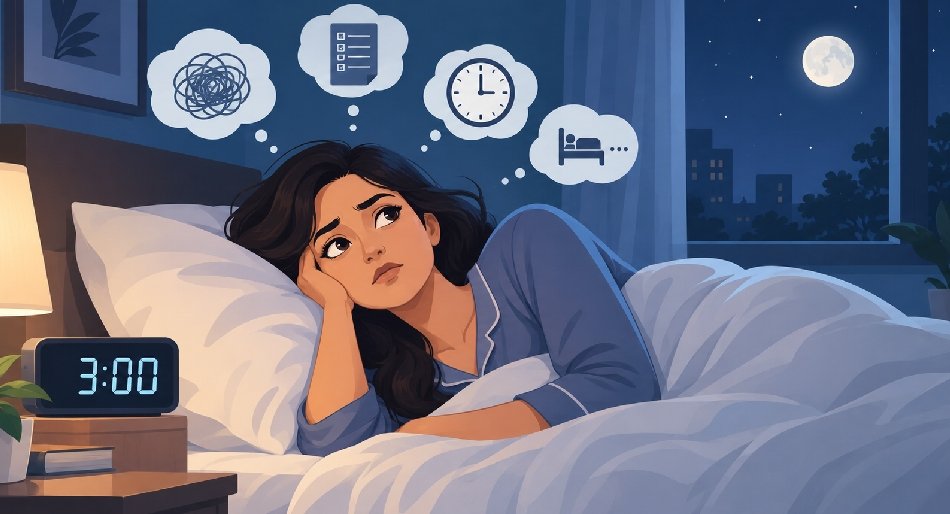
You glance at the clock. It’s 3 a.m. again, and your mind is already replaying tomorrow’s deadlines. Waking at the same hour night after night has a name: sleep-maintenance insomnia, the middle-of-the-night pattern that keeps you awake when your body should be resting.
Key Takeaways
- Waking at 3 a.m. occasionally is normal — it becomes a problem only when it repeats most nights and leaves you exhausted by day.
- Maintenance insomnia means trouble staying asleep or waking too early, and Harvard Health calls it the most common insomnia pattern.
- The 20-minute rule is your best in-the-moment tool: leave bed, keep lights dim, skip the phone, and return only when sleepy.
- A fixed wake time, an early-afternoon caffeine cutoff, and no nightcap rebuild restful sleep over two to four weeks.
- Nightly waking with loud snoring, gasping, or crushing daytime sleepiness may signal sleep apnea, and a sleep study settles it.
Why Do I Keep Waking Up at the Same Time Every Night?
Your body’s clock, not the one on your bedside table, usually explains the pattern. Cortisol, your alertness hormone, starts rising in the early morning hours to prepare you for the day, and you spend more time in lighter, easily disturbed sleep after 3 a.m. (Harvard Health, 2025). When stress is already high, that gentle signal turns into a full wake-up call.
Sleep runs in roughly 90-minute cycles. The second half of the night holds more light sleep and dreaming, so brief awakenings between cycles are normal. Most people roll over and never remember them. You remember the 3 a.m. wake-up because something keeps your brain switched on at that exact transition.
Common culprits: a heavy late dinner that drops blood sugar in the small hours, alcohol that wears off by the second half of the night, caffeine from evening chai, and daytime anxiety your brain rehearses when distractions fall away.
Is Waking Up at 3 AM a Sign of a Sleep Disorder?
Not every 3 a.m. wake-up is a disorder, but a clear pattern can be. Sleep-maintenance insomnia is difficulty staying asleep, waking repeatedly, or waking too early and failing to get back to sleep — and it is the most common form of insomnia (Harvard Health, 2021). Roughly 12–20% of adults live with insomnia of some kind (NIH MedlinePlus, 2021), and Indian studies put the figure even higher.
Doctors call it insomnia disorder when the pattern runs at least three nights a week for three months or longer and causes daytime impairment — fatigue, poor concentration, or low mood (NHLBI, NIH). Waking once or twice a week after a stressful day is not insomnia. Waking most nights, at the same hour, for months, is worth treating rather than enduring.
Anxiety commonly drives the 3 a.m. pattern: cortisol peaks in the early morning, and a stressed brain amplifies that signal. If you also snore loudly or your partner notices breathing pauses, sleep apnea could be fragmenting your night instead. Not sure which one fits you? Use this self-check guide to tell insomnia and sleep apnea apart before you assume.
What Should You Do When You Wake Up at Night?
Lie in bed and fight it, and you train your brain to treat bed as a place for worrying. The 20-minute rule breaks that habit: if you are still awake after roughly 20 minutes, get up (American Academy of Sleep Medicine). This is the core of stimulus control, the behavioral technique behind CBT-I.
- Leave the bedroom. Move to a dimly lit room or a comfortable chair elsewhere in the home.
- Do something quiet. Read a paper book, fold laundry, or practice slow breathing. Nothing stimulating.
- No phone, no laptop, no clock. Screens and time-checking feed alertness and anxiety. Turn the clock away from view.
- Skip the work messages. That 3 a.m. WhatsApp or email thread will still be there in the morning.
- Return to bed only when sleepy. If sleep does not come within another 20 minutes, repeat the cycle.
Racing thoughts are the usual saboteur. Keep a notepad by your bed and write tomorrow’s tasks down before switching off the light, so your brain stops rehearsing them at 3 a.m. When worry surfaces, slow your breathing — a long exhale calms your nervous system and nudges you back toward sleep.
Still waking at 3 a.m. most nights?
Dr. Nalini Nagalla, pulmonologist and sleep specialist in Hyderabad, can pinpoint the cause.
How Can You Stop Middle-of-the-Night Waking?
Long-term fixes target the drivers behind the 3 a.m. pattern, and they work best as a consistent routine rather than a one-night experiment. The single most powerful habit is a fixed wake time: rise at the same hour every day, including weekends, even after a poor night. That anchors your circadian rhythm and rebuilds sleep pressure for the following night.
Next, audit what enters your body in the afternoon and evening. Caffeine can linger in your system for hours, so make early afternoon your cutoff — for many people, that means replacing evening filter coffee with a herbal option. Alcohol is subtler: it helps you doze off, then fragments the second half of the night as it clears, which is precisely when you wake at 3 a.m. Keep most nights alcohol-free.
Build a 30-to-60-minute wind-down that signals sleep is coming: dim the lights, close the laptop, put the phone away, and choose a calm activity. A warm shower, light reading, or gentle stretching all work. Finish dinner at least two to three hours before bed so digestion stays calm overnight, and schedule a daily worry time in the early evening to park anxieties before they reach your pillow.
These habits form the foundation of cognitive behavioral therapy for insomnia, the first-line, medication-free treatment for chronic cases. For the full protocol, see our guide to Stanford-approved CBT-I in Hyderabad.
The Hyderabad Factor in Middle-of-the-Night Waking
Hyderabad professionals face a perfect storm for the 3 a.m. wake-up. Long workdays and commutes push dinner to 9 or 10 p.m., evening filter coffee is a social habit, and the phone follows many people into bed. Each element quietly feeds sleep-maintenance insomnia, and together they make the pattern stubborn.
A few local adjustments can break the cycle:
- Move dinner earlier. A heavy late meal keeps digestion and blood sugar working through the night, which can surface as a 3 a.m. adrenaline wake.
- Switch the evening brew. Filter coffee after 4 p.m. can stay active well into the small hours. Choose decaf or herbal chai instead.
- Set a phone wind-down. Schedule Do Not Disturb from 10 p.m., and resist the pull of late work chats.
- Skip weekend sleep-ins. Sleeping till noon on Sunday resets your clock and guarantees a restless Monday night.
None of this needs willpower at 3 a.m. The work happens during the day, when you actually have control.
When Should You See a Sleep Specialist?
See a sleep specialist when the pattern turns chronic — three or more nights a week for over three months — or when red flags point beyond simple insomnia. Maintenance insomnia is common, but it can also mask sleep apnea, restless legs, or other conditions that need their own treatment.
- Your partner reports loud snoring, gasping, or pauses in your breathing
- You wake with a racing heart, dry mouth, or morning headache
- You rush to the bathroom repeatedly through the night
- Daytime sleepiness makes you nod off at work or while driving
- You still feel exhausted after seven or eight hours in bed
- Insomnia persists despite good sleep habits for several months
A sleep study is the reliable way to separate the causes. It records your breathing, oxygen levels, and brain waves through one night and shows whether apnea, insomnia, or both are fragmenting your sleep. If daytime exhaustion dominates your mornings, our guide to waking up tired every day explains what else could be going on.
Chronic insomnia is treatable without sleeping pills. The first step is a proper evaluation — one night of data beats months of guessing.
Ready to sleep through the night again?
Get a proper evaluation for insomnia, apnea, or both at Dr. Nalini Nagalla’s sleep clinic in Hyderabad.
