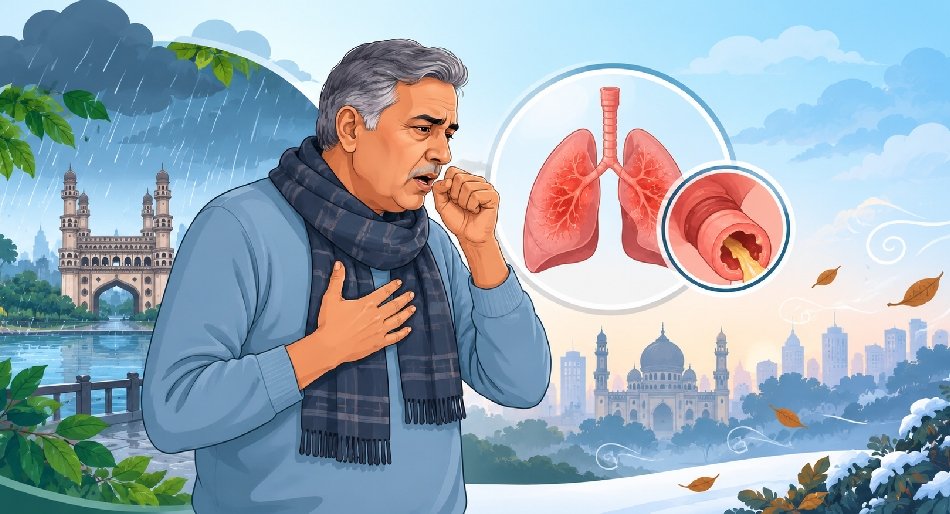
Hyderabad hands your lungs two difficult seasons every year. Monsoon air sits at 70 to 90 percent humidity, and the cool, still weeks from November trap dust and fumes close to the ground. For the millions of Indian adults living with COPD, that swing decides how many good days the year holds.

COPD doesn’t get managed once and forgotten. It responds to the season, the air outside your window, and the habits you keep between clinic visits. This guide covers what triggers flare-ups here, how to catch one early, and which vaccines to line up before winter.

Key Takeaways

  • COPD flare-ups in Hyderabad cluster in two windows: the humid monsoon months and the dry, dusty weeks from November to February.
  • Most flare-ups start with a chest infection or a spike in air pollution, so vaccines and a written action plan carry weight.
  • Inhaler problems are common, not rare. About 58 percent of people with COPD use their inhaled medicines suboptimally (Chronic Respiratory Disease, 2016).
  • COPD doesn’t reverse, yet treatment changes the course: rehab after a flare-up nearly halves readmissions (Thorax, 2025).


Why Does COPD Flare Up More Often in Hyderabad?

COPD is still one of the world’s biggest killers. An estimated 213.4 million people were living with it in 2021, when it caused 3.7 million deaths worldwide (Global Burden of Disease study, 2025). In India, pooled adult data put prevalence at 7.4 percent (systematic review, 2021).

Air quality swings harder here than in most Indian cities. Rain washes the air clean through the monsoon, then winter cold settles low and traps what the city produces. Hyderabad’s winter PM2.5 runs roughly three times its monsoon level (Science of the Total Environment, 2019).

Damaged lungs tolerate that swing badly. Airways already carrying inflammation and mucus can’t absorb a bad air day or a mild infection the way healthy lungs can. If your COPD came as a surprise because you never smoked, our guide to non-smoker COPD in India and our piece on difficult-to-treat asthma explain the usual causes.

Local pattern: patients who feel steady in July walk in breathless by mid-November.


Monsoon, Post-Monsoon and Winter: What Changes for Your Lungs

Each season brings its own trigger. Monsoon months in Indian megacities carry 65 to 85 percent less fine particulate matter than winter months (Science of the Total Environment, 2019), and higher pollution links to more exacerbations and longer hospital stays (Journal of Thoracic Disease, 2019).

SeasonWhat Changes in HyderabadWhat Helps
Monsoon (June to September)Humidity 70 to 90 percent, fungal spores rise, chest infections climbTreat infections early, store inhalers dry, ventilate rooms
Post-monsoon (October to November)Air dries, dust rises, festive smoke settlesClean AC filters, avoid smoke, book vaccines now
Winter (November to February)Cold air traps pollutants; PM2.5 about triple monsoon levelsCheck AQI before walks, mask outdoors, carry your reliever


How Do You Spot a Flare-Up Before It Fully Hits?

A flare-up is any change in breathlessness, cough, or sputum that goes past your normal day-to-day variation (GOLD 2025 report). Caught early, most settle with an inhaler change or a short steroid course at home.

Signs to watch for:

  • Breathlessness during routine things, like your usual stairs or the walk to the gate
  • Sputum that turns yellow, green, or thicker than usual
  • Wheezing, chest tightness or night waking that wasn’t there last week
  • Needing your reliever inhaler more often
  • Ankle swelling, drowsiness or bluish lips, which need urgent care

Most flares trace back to an infection, which is why monsoon lung infections in Hyderabad are worth treating early rather than waiting out.

ZoneWhat You NoticeWhat to Do
GreenBreathing at baseline, sleep fine, activity unchangedKeep taking daily inhalers, stay active, avoid smoke
YellowMore breathless than usual, phlegm changing colour, waking at nightStart your written action plan, call your pulmonologist the same day
RedBreathless at rest, can’t finish a sentence, confusion, chest painEmergency care now. Don’t wait for the morning

Breathless more often than you used to be?

Get your lungs checked before the season turns.

Book a Consultation


How Do You Get Inhaler Technique and Adherence Right?

Inhalers only work when the medicine reaches your airways. In one study of 150 patients with COPD, 58 percent reported suboptimal adherence, and technique errors turned up with every device type, in 50 to 83 percent of users (Chronic Respiratory Disease, 2016).

That explains a puzzle patients bring to clinic: the prescription can be perfect and the breathing still poor, because the spray landed on the throat instead of inside the lungs.

  • Bring every inhaler to every appointment, and ask your doctor to watch you use each one
  • Use a spacer with metered-dose inhalers if your doctor recommends one
  • Rinse your mouth after steroid inhalers, and never double up on a missed dose
  • Link doses to fixed daily events, like brushing your teeth
  • Track your reliever use. A rising number is early warning


Which Vaccines Should You Take Before Winter Arrives?

The 2025 GOLD strategy, the international standard for COPD care, recommends influenza, pneumococcal, RSV, COVID-19, pertussis and shingles vaccines for people with COPD, following current CDC guidance (GOLD 2025). The payoff is measurable: across 56,652 matched pairs, influenza vaccination was linked to a 39 percent lower risk of hospitalised influenza (Clinical Microbiology and Infection, 2026).

  • Influenza: every year, ideally by October, since protection takes about two weeks
  • Pneumococcal: one dose of PCV20, or PCV15 followed by PPSV23, as your doctor advises (CDC)
  • RSV: for adults over 60, or anyone with chronic heart or lung disease
  • COVID-19: keep it current alongside the rest
  • Tdap and shingles: worth asking about if you missed them

A respiratory infection is the most common flare-up trigger, which is why these shots matter more with COPD. Our guide to why the flu shot matters covers the timing.


Can COPD Get Better?

COPD itself doesn’t reverse, and no medicine removes damage already done. The WHO says it plainly: COPD isn’t curable, but symptoms can improve when you stop smoking, avoid polluted air and take the recommended vaccines, with treatment through inhalers, oxygen and pulmonary rehabilitation (WHO).

Here’s where patients get the wrong message: a disease that can’t be cured is not the same as one that can’t improve.

Two findings matter here. Pulmonary rehabilitation started within three weeks of a flare-up cut readmissions by nearly half (odds ratio 0.48) and improved walking distance (Thorax, 2025). A single flare-up nearly doubles the rate of lung function decline, from about 39 to 76 millilitres a year in one UPLIFT analysis. Preventing flares is treatment, not comfort.

So the honest answer: your lungs won’t return to how they were, but breathing can get easier and hospital visits can drop.


Living With Stage 3 COPD: What the Evidence Shows

Stage 3, or GOLD 3, means your FEV1 sits between 30 and 49 percent of predicted, and symptoms limit daily activity. The stage doesn’t hand you a timeline: survival varies widely, because breathing capacity is only part of the picture.

A 2025 cohort reported five-year survival of 89.7 percent in its COPD population, with lower survival among people over 65, those with heart failure, and those with FEV1 at or below 35 percent (cohort study, 2025). GOLD separately notes five-year mortality after hospital admission for a severe flare-up around 50 percent. Both numbers are real, and they describe different patients.

What tilts the odds in your favour:

  • Fewer flare-ups, since each one raises the risk of the next (GOLD 2025)
  • Stopping smoking completely, at any stage
  • Pulmonary rehabilitation, which improves stamina and survival odds
  • Vaccines before each season, and oxygen therapy when prescribed
  • Treating conditions that travel with COPD, such as heart disease, sleep apnea and diabetes

One number to focus on: how often you flare. It predicts your next year better than any single breathing test, and it’s the measure you influence most.

This is the season to protect your lungs from city air, refill medications before they run low, and put your action plan in writing.

Want a plan built for your lungs before winter sets in?

Dr. Nalini Nagalla treats COPD, asthma and sleep disorders in Hyderabad, with a flare-up plan you can follow at home.

Book a Consultation Today

Frequently Asked Questions
Can COPD get better?
COPD doesn't reverse and no medicine removes damage already done. The WHO notes that symptoms can still improve when you stop smoking, avoid polluted air and take the recommended vaccines, with treatment through inhalers, oxygen and pulmonary rehabilitation. Pulmonary rehabilitation started soon after a flare-up cut hospital readmissions by nearly half (Thorax, 2025).
How long can someone live with stage 3 COPD?
Stage 3 COPD doesn't carry a fixed timeline. A 2025 cohort reported five-year survival of 89.7 percent overall, with lower survival when FEV1 falls to 35 percent or below, while GOLD reports around 50 percent five-year mortality after hospital admission for a severe flare-up. Flare-up frequency, smoking status and heart health shift the odds more than the stage label does.
Does Hyderabad's air quality make COPD worse?
Yes. Monsoon months in Indian megacities carry 65 to 85 percent less fine particulate matter than winter months (Science of the Total Environment, 2019), so November to February is the highest-risk stretch in Hyderabad. Higher pollution is linked to more exacerbations and longer hospital stays (Journal of Thoracic Disease, 2019). Checking the AQI before your morning walk helps.
Which vaccines should a person with COPD take before winter?
GOLD 2025 recommends influenza, pneumococcal, RSV, COVID-19, pertussis and shingles vaccines for people with COPD, in line with CDC guidance. Take the flu shot by October, since protection takes about two weeks to build. Across 56,652 matched pairs, influenza vaccination was linked to a 39 percent lower risk of hospitalised influenza (Clinical Microbiology and Infection, 2026).
What should I do at home during a COPD flare-up?
Follow your written action plan: use your reliever inhaler as advised, start any prescribed steroid course, and call your pulmonologist the same day if your phlegm changes colour or you wake at night breathless. Go to hospital for breathlessness at rest, confusion or chest pain. Most flares settle fast when treated in the first day or two.

Dr. Nalini Nagalla is a Consultant Pulmonologist & International Sleep Specialist with over 24 years of clinical experience in respiratory and sleep medicine. She specializes in the diagnosis and management of asthma, COPD, interstitial lung disease, tuberculosis, and sleep disorders. A Fellow in Sleep Medicine and CBT-I certified by Stanford University, she currently leads the respiratory care unit at Arete Hospital, Hyderabad, delivering evidence-based, patient-centered care.

Quick Call