
Key Takeaways
- Insomnia is trouble falling or staying asleep; sleep apnea is breathing that pauses while you sleep.
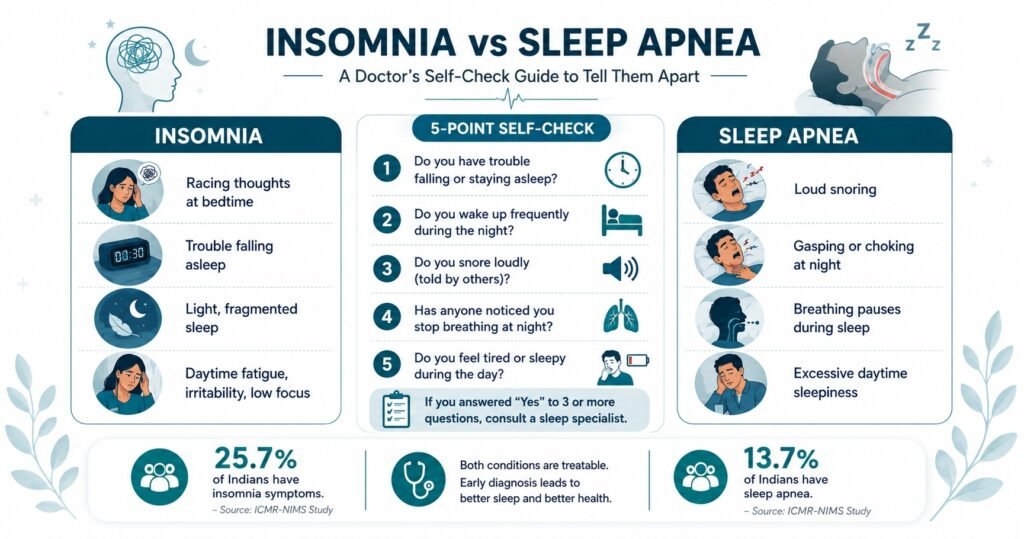
- Roughly 25.7% of Indians struggle with insomnia, while 13.7% have obstructive sleep apnea (OSA).
- Both can coexist. Called comorbid insomnia and sleep apnea (COMISA), they need different treatments.
- Loud snoring, gasping, and daytime sleepiness point to apnea; racing thoughts at bedtime point to insomnia.
- A sleep study or home sleep test settles the diagnosis. You don’t have to guess.
Why Does the Difference Matter for Your Treatment?
Confusing the two conditions is common, and it costs people years of restless nights. Insomnia responds to therapy and sleep-hygiene changes, while sleep apnea often needs CPAP or other medical treatment. Treat the wrong one, and nothing improves.
Sleep disorders are far from rare in India. A systematic review pooling Indian studies found insomnia affects 25.7% of the population and obstructive sleep apnea affects 37.4% (medRxiv systematic review, 2023). That means millions of people are lying awake or gasping for air, often without knowing which problem they actually have.
The good news? You can usually tell them apart at home with a few honest questions. This guide walks you through the key differences, a quick self-check, and the signs that mean it’s time to see a specialist.
What Does Insomnia Actually Feel Like?
Insomnia is a problem with sleep onset or maintenance. Your body wants to sleep, but your brain won’t cooperate. You lie in bed with a racing mind. You wake up at 3 a.m. and can’t drift off again. Some nights, sleep never really comes.
The key marker is hyperarousal. Anxiety about sleep itself, stress, caffeine, or irregular schedules keep the nervous system switched on. Even when you do sleep, it feels light and unrefreshing. You might sleep 6 hours and still wake up exhausted, but the problem is the quality and continuity, not your breathing.
Insomnia tends to be chronic when it lasts more than three months. It’s diagnosed on symptoms alone, so no sleep study is strictly required, though one helps rule out apnea. If you want a deeper look at a non-drug treatment that works, read our guide to CBT-I in Hyderabad, a Stanford-approved approach to insomnia. Simple daily routines in our sleep hygiene tips can also reset your nights.
How Is Sleep Apnea Different?
Sleep apnea is physical, not psychological. Your airway collapses or gets blocked during sleep, stopping your breathing for seconds at a time, sometimes dozens of times an hour. Each pause wakes your brain just enough to restart breathing, fragmenting your sleep without you remembering it.
The clues are hard to ignore once you know them. Loud snoring. Gasping or choking sounds. Pauses in breathing that your partner notices. Crushing daytime sleepiness. Around 13.7% of Indian adults have OSA (ResMed India prevalence data, 2025), and most don’t know it.
Apnea rarely feels like “can’t fall asleep.” Most people with OSA fall asleep easily, often too easily, even mid-conversation. The disorder shows up in how you feel all day, not just how you sleep at night. For the full picture of what apnea treatment involves, see our guide to sleep apnea treatment in Hyderabad.
What Are the 5 Main Differences Between Insomnia and Sleep Apnea?
This comparison table summarizes what separates the two and why they need different treatments.
| Feature | Insomnia | Sleep Apnea |
|---|---|---|
| Main problem | Trouble falling or staying asleep | Breathing pauses during sleep |
| Typical bedtime | Racing mind, can’t switch off | Falls asleep fast, sometimes anywhere |
| Snoring | Usually mild or absent | Loud, frequent, with gasping |
| Partner’s report | “You toss and turn” | “You stop breathing” |
| Daytime effect | Fatigue, irritability, anxiety | Sleepiness, brain fog, morning headaches |
| Best first treatment | CBT-I, sleep hygiene, stress management | CPAP, weight loss, positional therapy |
One important overlap: the two can happen together. Studies show a significant share of people with sleep apnea also report insomnia symptoms. This combination is called comorbid insomnia and sleep apnea, or COMISA (Sleep Medicine research, 2025). If you snore loudly AND struggle to fall asleep, you might be dealing with both.
Quick Self-Check: Which One Sounds Like You?
Answer honestly. This isn’t a diagnosis, but it points you in the right direction. No one else has to see it.
1. How fast do you fall asleep?
Easily, even in cars or meetings → leans apnea. Takes 30+ minutes with racing thoughts → leans insomnia.
2. Do you snore?
Loudly, every night, with pauses → apnea. Rarely or softly → insomnia.
3. Have you ever woken gasping or choking?
Yes → apnea. Never → insomnia.
4. What wakes you?
Nothing specific, just light sleep at 3 a.m. → insomnia. Your own breathing, or a partner shaking you → apnea.
5. How do you feel at 3 p.m.?
Drained and wired → insomnia. Fighting to keep your eyes open → apnea.
Most people score mostly one column. If you see apnea signs in three or more answers, a sleep study is worth doing even if you also have insomnia symptoms.
When Should You See a Sleep Specialist in Hyderabad?
You don’t need to live with guessing. See a pulmonologist or sleep specialist if any of these apply to you:
- Your partner reports loud snoring with pauses or gasping
- You wake up gasping, choking, or with a racing heart
- Daytime sleepiness interferes with work or driving
- Insomnia has lasted more than three months despite good sleep habits
- You wake with headaches, dry mouth, or unrefreshing sleep regularly
Delaying matters. Untreated sleep apnea raises the risk of high blood pressure, heart disease, and diabetes. Chronic insomnia carries its own toll on mood, focus, and immunity. Both are treatable, and the first step is knowing which one you’re dealing with.
How Do Doctors Confirm the Diagnosis?
If your self-check points to sleep apnea, a sleep study is the gold standard. That can be done in a sleep lab or, increasingly, at home with a portable device that tracks your breathing, oxygen, and heart rate overnight.
For insomnia, your doctor will review your history and sleep patterns, often asking you to keep a sleep diary. Questionnaires like the Epworth Sleepiness Scale help separate sleepiness from fatigue. In some cases a study is still ordered, mainly to rule out apnea hiding behind insomnia symptoms.
The right diagnosis changes everything. Insomnia gets therapy and habits; apnea gets CPAP and sometimes weight-loss support. With the correct treatment, most people feel a difference within weeks.
The Bottom Line
Insomnia is a problem with falling or staying asleep; sleep apnea is a problem with breathing during sleep. The treatments could not be more different, and guessing wrong wastes months of your life.
Use the self-check above. If you’re torn, or you snore loudly, a sleep study settles it. Don’t spend another night guessing.
Need a proper sleep evaluation in Hyderabad?
Book a consultation with Dr. Nalini Nagalla, pulmonologist and sleep specialist.
