
Key Takeaways
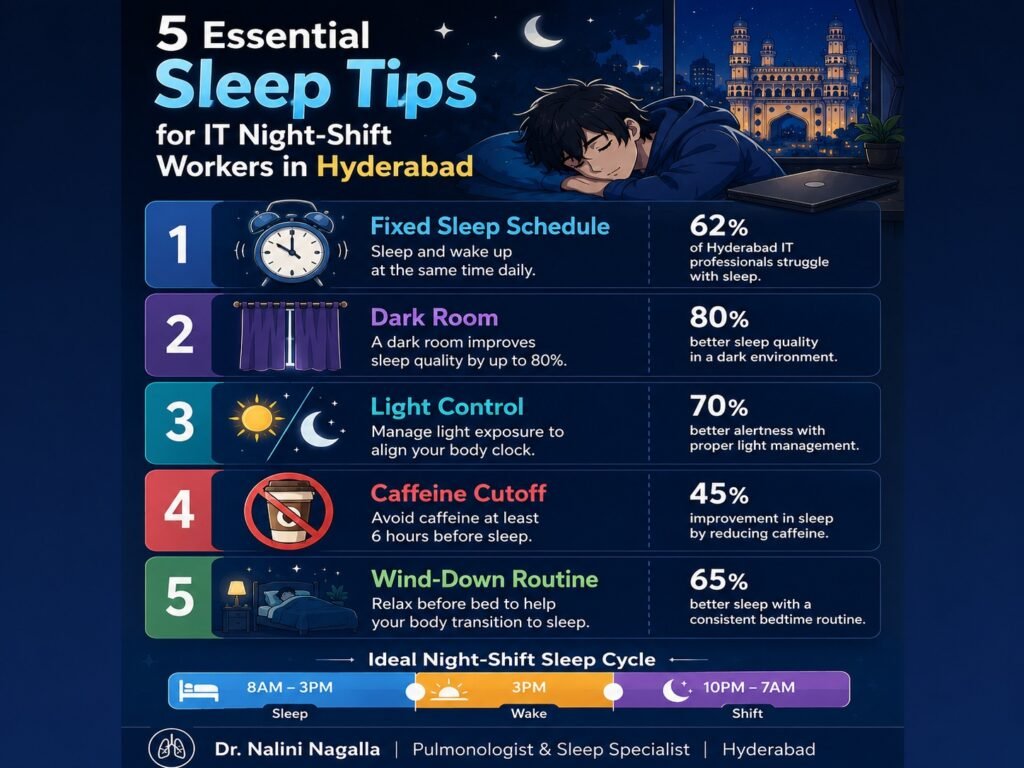
- 62% of Hyderabad IT professionals report difficulty sleeping, and 97% use electronic devices within an hour of bed — a critical sleep hygiene gap in the city tech community (MediCircle / Times of India).
- Blackout curtains, a fixed sleep schedule, and stopping caffeine 4–6 hours before bed deliver the biggest measurable improvement for night-shift workers.
- 56% of Indian software engineers in studied samples met clinical insomnia criteria — roughly double the general population rate.
- For persistent sleep problems despite good sleep hygiene, Dr. Nalini Nagalla offers sleep consultations at her Gachibowli clinic.
Introduction: Why IT and Night Shifts Disrupt Sleep in Hyderabad
Hyderabad’s IT corridor runs around the clock. Global client handoffs, rotating shift schedules, and late-night sprints leave thousands of engineers, support staff, and managers sleeping by day. Daytime sleep is biologically harder. Daylight streams through windows, traffic noise rises, and the body resists shutting down when sunlight says “wake up.”
The cost shows up in health records. A survey of Hyderabad IT professionals found 62% reported difficulty sleeping, with 97% using electronic devices for at least one hour before bed (MediCircle / Times of India). Another study of Indian software engineers found 56% met insomnia criteria, compared to 23% in the general population (PubMed). Night-shift workers show even higher rates: one study found 100% of Indian IT night-shift workers had poor sleep quality on standard measurement scales (PubMed).
This post covers five evidence-based strategies. They are practical, low-cost, and targeted specifically at Hyderabad’s tropical climate and IT work culture. If you sleep 6–8 hours in a dark, cool room, control daytime light exposure, cut caffeine at the right time, and protect your pre-sleep window, you can substantially improve sleep even on a reversed schedule.
1. Set a Fixed Sleep Window — Sleep at the Same Time, Even on Weekends
A consistent sleep–wake schedule is the single most powerful circadian stabilizer available. Disrupting it by more than two hours on weekends increases daytime sleepiness and reduces sleep efficiency (Sleep Foundation, 2025).
Night-shift workers in Hyderabad often swing between two incompatible schedules: sleeping 8 AM to 3 PM on working days, then shifting back to 11 PM–6 AM on weekends to catch family dinners or social events. That weekly flip resets your circadian clock every Monday and Friday, making deep sleep harder to reach and daytime sleep lighter. Researchers call this “social jet lag,” and it is strongly linked to worse mood, slower reaction time, and longer-term metabolic risk (PubMed).
What a stable window looks like
If your night shift runs 10 PM to 7 AM, target a main sleep block of 8:30 AM to 3:30 PM (seven hours). On off days, keep sleep between 11 AM and 5 PM if you must shift later—do not abandon daytime sleep entirely. If you nap before the shift, cap it at 20–30 minutes and finish by 7:45 PM so it does not delay your main sleep (PMC).
How to lock the schedule in place
- Set a hard phone alarm for both sleep start and sleep end.
- Block daytime noise with blackout curtains and an eye mask.
- Tell family or flatmates your fixed sleep hours so they do not knock, vacuum, or call unnecessarily.
- Use bright light immediately after waking to reinforce the new “morning.”
Hyderabad’s weekend social events—weddings, family gatherings, festivals—make this hardest. The practical compromise is a maximum two-hour shift, not a full day–night flip. Even small consistency gains reduce sleep-onset latency substantially over a month (UCLA Health, 2023).
2. Blackout Your Room: Create a True “Night” During the Day
Daytime sleep is naturally shorter and lighter than nighttime sleep because of light exposure. Engineering a dark sleep environment reduces awakenings and increases deep-sleep duration (Sleep Foundation, 2025).
Hyderabad’s intense tropical sun is the primary daytime sleep enemy. Even indirect daylight through curtains suppresses melatonin—the hormone that signals your body to sleep. For night-shift workers sleeping during daylight, creating a “fake night” in the bedroom is not optional; it is a medical-grade sleep intervention.
What you need
| Item | Purpose | Typical cost |
|---|---|---|
| Blackout curtains | Block 90–99% of sunlight | ₹1,500–₹4,000 |
| Eye mask (silicone or padded) | Seal out residual light | ₹300–₹800 |
| Earplugs or white-noise machine | Mask traffic, construction | ₹100–₹2,000 |
| AC or cooler | Keep room 20–24 °C for deep sleep | Existing appliance |
Setup tips for Hyderabad homes
- Use dark-colored bedsheets or black chart paper as a low-cost curtain supplement if blackout panels are not immediately affordable (Times of India).
- Run the AC between 20–24 °C; warmer bedrooms reduce sleep efficiency (Sleep Foundation).
- Use a fan or white-noise app to mask traffic from the main road and construction noise common in HITEC City, Gachibowli, and Madhapur.
- Put your phone on Do Not Disturb; allow only emergency contacts through.
Why this works
An environment that genuinely mimics darkness allows melatonin to rise naturally. Clinical shift-work research shows blackout-rated sleep environments reduce daytime sleep fragmentation and improve alertness during the night shift (PMC). The investment pays for itself within weeks in improved work performance and fewer sick days.
3. Use Light Strategically: Bright During Work, Dark Before Sleep
Bright light exposure at the right time acts as a circadian schedule reset button. Night-shift workers exposed to bright light during the first half of their shift stay more alert, while wearing sunglasses on the morning commute protects the sleep window (Health Partners, 2025).
Light is the most powerful external signal controlling your sleep–wake clock. You can use it to sharpen alertness during the shift and deepen sleep afterward—with the same two levers: when to get bright light and when to block it.
During the shift (10 PM to 2 AM)
Keep your workspace brightly lit. Use overhead office lighting and a monitor at comfortable brightness. Some night-shift workers add a bright desk lamp in the first half of the shift to reinforce alertness (Health Partners, 2025). Avoid dimming your screen—brightness signals your brain to stay engaged.
After the shift, going home (3 AM to 7 AM)
Wear sunglasses on your commute. Morning sunlight is the strongest brightness signal your body receives. If your eyes take in bright Hyderabad sun at 6 AM, your brain interprets it as “start the day,” which delays melatonin rise and makes falling asleep harder (San辙, 2026). Dark wraparound sunglasses are a low-cost, high-impact tool.
Before sleep (7:30 AM onward)
Dim hallway and bathroom lights. Use warm-toned bulbs (2700K or lower) instead of cool white (5000K+). Keep your phone out of reach or on a red-filter night mode. Do not scroll through work email for the last 30 minutes before attempting sleep—this cue keeps your brain in “problem-solving” mode (Cleveland Clinic Health).
After waking (after 3 PM)
Get 3–4 hours of bright light after waking from your main sleep block. Step onto the balcony, sit near a sunlit window, or take a brief walk outdoors. This anchors your new wake time and stabilizes the schedule for the next day (Sleep Foundation, 2025).
4. Cut Caffeine at the Right Time — Stop Several Hours Before Sleep
Caffeine has a half-life of 5–6 hours, meaning a 200 mg coffee at 3 AM is still half-active in your system at 9 AM, right when you are trying to sleep (Hours, 2025). Strategic caffeine timing is one of the most underused sleep interventions for night-shift workers.
Hyderabad IT offices run on tea and coffee. Many night-shift workers drink their first cup at 9 PM and continue sipping through midnight. That pattern directly damages the sleep window. Caffeine blocks adenosine, the chemical that builds sleep pressure while you are awake. If adenosine cannot accumulate, you will not feel sleepy when your head hits the pillow at 8 AM.
The caffeine clock for a 10 PM–7 AM shift
| Time | Caffeine status |
|---|---|
| 9:30 PM | First cup of tea/coffee allowed |
| 12:00 AM | Last strong coffee; switch to water |
| 3:00 AM | No more caffeine; light snacks only |
| 7:30 AM (post-shift) | Caffeine stopped 4+ hours before sleep |
Practical alternatives during the shift
- Water with lemon — keeps you hydrated and avoids the afternoon-energy crash that triggers a second coffee.
- Green tea — lower caffeine than coffee, includes L-theanine for steadier alertness.
- Buttermilk or chaas — culturally familiar in Hyderabad, cooling, and caffeine-free.
- Nuts and fruit — walnuts, almonds, bananas, and oranges provide natural energy without the caffeine spike-and-crash cycle.
The pre-sleep hard stop
Set a firm 4-hour caffeine cutoff before your planned sleep time. If you sleep at 8:30 AM, caffeine stops at 4:30 AM. This rule alone reduces sleep-onset latency significantly (Cleveland Clinic Health). Avoid energy drinks entirely; they produce a sharper spike and harsher crash than coffee.
5. Protect the Pre-Sleep Wind-Down and Guard Your Bedroom Boundary
A 20–40 minute wind-down routine before sleep reduces the time needed to fall asleep by an average of 31% in night-shift Indian IT workers (PubMed). Consistency matters more than the specific activity chosen.
After a night of debugging, client calls, and screens, your nervous system is in a high-alert state. Walking through the door at 7:30 AM and going straight to bed rarely works. Your brain needs a clear signal that the workday is over and sleep is coming.
The 20-minute wind-down protocol
- Warm shower (5–7 minutes): The post-shower body temperature drop mimics the natural pre-sleep thermoregulation cue.
- Light stretching or breathing exercise (5 minutes): 4-7-8 breathing (inhale 4, hold 7, exhale 8) reduces sympathetic nervous system activity (Cleveland Clinic Health).
- Physical book or journaling (5–8 minutes): Reading a print book, or writing a short list of work concerns to “park” them for tomorrow, reduces pre-sleep cognitive arousal.
- Screen off (final 10 minutes before sleep): Phone, laptop, and tablet screens emit blue light that suppresses melatonin. If screens are unavoidable, use night mode at minimum brightness.
Bedroom as sleep-only territory
Do not take work laptops, work calls, or intense gaming into bed. The brain forms strong associations between context and behavior. If you code in bed three nights a week, your brain learns “bed = mental engagement” instead of “bed = sleep,” which increases insomnia risk over time (UCLA Health, 2023).
What to avoid in the wind-down window
- Checking production alerts or work email on your phone.
- High-stakes gaming or social media arguments.
- Heavy exercise (gym sessions should happen 2+ hours before sleep).
- Large meals, especially heavy biryani, fried snacks, or acidic curries within 3 hours of sleep (NutriNomNom /IJCM).
Realistic One-Day Sleep Schedule for Hyderabad IT Night Shifts
Use this as a starting template. Adjust by 30 minutes to match your actual shift timings and commute. For personalized guidance, visit our sleep disorder specialist page or book an appointment.
| Time block | Activity |
|---|---|
| 7:30 AM | Shower, dim lights, wind-down begins |
| 8:00 AM – 3:00 PM | Main sleep (blackout + earplugs + white noise) |
| 3:00 PM – 3:20 PM | Wake, open curtains, bright light, tea + light breakfast |
| 3:30 PM – 5:30 PM | Exercise, family time, personal errands |
| 5:30 PM – 6:30 PM | Main meal (dal, roti, sabzi, curd — moderate portions) |
| 6:30 PM – 7:30 PM | Nap if needed (max 20–30 min) |
| 7:30 PM – 9:00 PM | Commute, light snack, first cup of tea |
| 9:00 PM – 10:00 PM | Shift prep, last caffeine at 3 AM |
| 10:00 PM – 7:00 AM | Night shift |
| 7:00 AM onward | Sunglasses on commute, shower, wind-down, sleep |
This schedule protects a 7-hour main sleep block, respects the caffeine cutoff, and anchors the circadian clock with morning bright light. Most IT professionals in Hyderabad can implement this with small adjustments to their current routine. For sleep disorder screening and treatment plans, explore our sleep disorder services.
When Good Sleep Habits Are Not Enough
Sleep hygiene—habits and environmental changes—fixes most shift-work sleep problems. For some professionals, however, underlying conditions like obstructive sleep apnea (OSA), insomnia disorder, or shift-work sleep disorder may require medical treatment.
If you are in Hyderabad and your sleep problems persist despite consistent sleep timing, blackout curtains, and caffeine management, a consultation with a sleep specialist is the right next step. CBT-I (Cognitive Behavioral Therapy for Insomnia) is the gold-standard, non-drug treatment for chronic insomnia and is available through trained practitioners in Hyderabad. In cases where structural anatomy contributes (such as narrow airway or positional sleep apnea), a comprehensive pulmonary and sleep evaluation gives you a precise diagnosis and a targeted treatment plan. Reach out via our contact page to schedule a visit.
Sleep is not a luxury. It is the foundation of cognitive performance, metabolic health, and emotional stability. For IT professionals managing critical systems and global clients, protecting sleep is a professional responsibility as much as a personal one.
Patient testimonial — Anitha Annadi, Local Guide:
“Dr Nalini Nagalla is a fantastic pulmonologist and sleep specialist. She was incredibly patient in explaining the results of my sleep study and helped me get started with a new treatment plan and lifestyle changes in a way that felt manageable. I never felt rushed during my visits. The difference in my daily energy levels has changed a lot. I strongly recommend her for anyone with sleep problems.”
Sources
- Cleveland Clinic Health. How You Can Sleep Better If You Work the Night Shift.
https://health.clevelandclinic.org/how-you-can-sleep-better-if-you-work-the-night-shift - Health Partners. Shift Work Sleep Tips.
https://www.healthpartners.com/blog/shift-work-sleep-tips/ - MediCircle. When the City Sleeps, They Can’t: India’s Night-Shift Warriors.
https://medicircle.in/when-the-city-sleeps-they-cant-indias-night-shift-warriors - National Library of Medicine (PMC). Shift Work Sleep Disorder: Impact on Health and Safety.
https://pmc.ncbi.nlm.nih.gov/articles/PMC7189699/ - National Library of Medicine (PubMed). Sleep Quality Among Indian IT Night-Shift Workers.
https://pmc.ncbi.nlm.nih.gov/articles/PMC13007107/ - PubMed. Prevalence of Insomnia Among Software Engineers in India.
https://www.medindia.net/news/poor-sleep-affects-software-engineers-in-india-study-77301-1.htm - Sleep Foundation. Shift Work Sleep Disorder: Tips for Better Sleep.
https://www.sleepfoundation.org/shift-work-sleep-disorder/tips - Times of India. Insomnia Grips City Youth, Techies.
https://timesofindia.indiatimes.com/city/hyderabad/insomnia-grips-city-youth-techies/articleshow/63326898.cms - UCLA Health. Coping With Shift Work.
https://www.uclahealth.org/medical-services/sleep-medicine/patient-resources/patient-education/coping-with-shift-work - NutriNomNom / IJCM. Night-Shift Nutrition for Hyderabad IT Professionals.
https://nutrinomnom.com/night-shift-nutrition-hyderabad-it-professionals/
