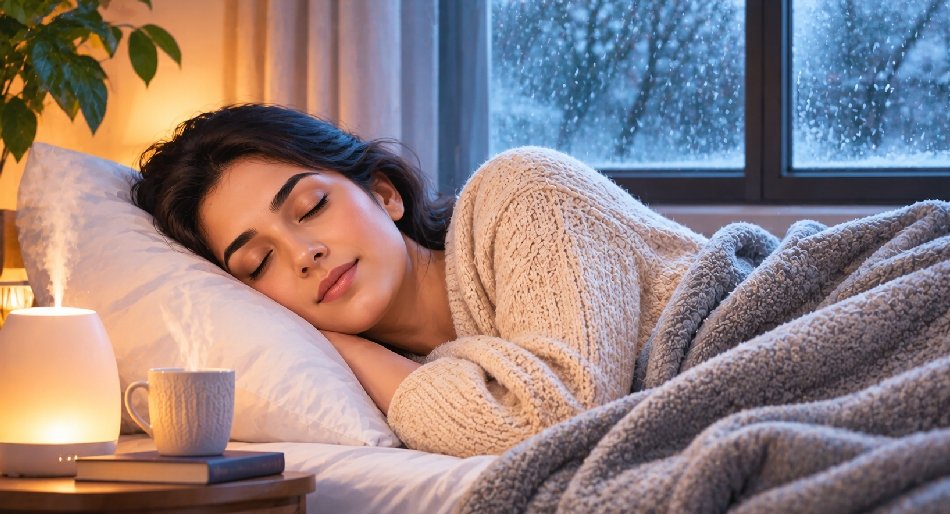
Hyderabad does not have a real winter. December nights sit around 14 to 16 degrees Celsius, and the coldest week rarely drops below 10. Yet every year between November and February, patients come to the clinic with the same complaint: their sleep has changed, and they cannot say why.

They are sleeping longer but waking unrefreshed. They are going to bed earlier but lying awake. Some wake at 3 or 4 in the morning and cannot get back to sleep. Nothing about their routine has changed except the weather.

There is a physiological explanation, and it is not the same as the winter sleep advice written for Europe and North America. This article explains what actually happens to your sleep in a Hyderabad winter, and what to do about it.

What happens to your body when the temperature drops?

Core body temperature is not constant. It follows a daily rhythm, dropping through the evening to reach its lowest point around 3 to 5 in the morning, then rising again before you wake. Sleep onset depends heavily on this drop: your body needs to shed about 1 degree Celsius of core heat to fall asleep comfortably.

That heat is shed through the skin, mostly from the hands, feet and face. In a warm room this happens easily. In a cold room, blood vessels near the skin constrict to conserve heat, which slows the heat loss and can delay sleep onset.

This is why the ambient temperature of your bedroom matters more than the temperature outside. A bedroom that is too cold produces the same problem as one that is too warm: the body cannot complete the cooling step that sleep depends on.

Why do you sleep more in winter?

Two mechanisms drive the seasonal change in sleep duration, and both are real.

Light exposure

Melatonin release is suppressed by light and triggered by darkness. In winter, sunset in Hyderabad falls around 5.45 pm, roughly an hour earlier than in June. People who work indoors and leave the office after dark may see very little natural light in the final hours of the day, which brings melatonin onset forward and makes them sleepy earlier.

Morning light matters as much. If you leave for work before sunrise and spend the day under artificial light, your circadian clock receives a weaker signal and drifts later, which produces the opposite complaint: difficulty waking in the morning despite feeling tired all evening.

Thermoregulation at night

During REM sleep, the body loses its ability to regulate temperature. This is one of the reasons cold bedrooms disturb the final third of the night more than the first. If your bedroom is cold, REM sleep is fragmented, which shows up as waking at 3 or 4 am rather than difficulty falling asleep.

Summer versus winter sleep: what actually changes

FactorHyderabad summerHyderabad winter
Typical night temperature26 to 30 C14 to 18 C
Main sleep problemDifficulty falling asleep, night waking from heatEarly waking, unrefreshing sleep, longer time in bed
Effect on sleep onsetDelayed, because core heat cannot be shedVariable, delayed if the room is too cold
Effect on REM sleepFragmented in unventilated roomsFragmented if bedding is too thin
Effect on total sleepShorterLonger, but often lower quality
Common complaint“I cannot sleep because of the heat”“I sleep more but still feel tired”
Air quality impactLower, windows openHigher indoor dust and allergen exposure, windows shut

The pattern is clear: summer shortens sleep, winter lengthens it but degrades quality. Neither is automatically better.

Is your winter sleep problem actually sleep apnea?

This matters more than the temperature question. Several sleep disorders become more noticeable in winter, and the seasonal change is a coincidence rather than a cause.

Obstructive sleep apnea is the most important. In winter, nasal congestion from cold air and indoor dust increases, and nasal obstruction raises the resistance in your upper airway. For someone with a mildly narrowed airway, this can be enough to convert borderline breathing into clear obstruction.

Cold air also triggers asthma and allergic rhinitis, both of which worsen night-time breathing. And winter bedding, often a heavier blanket and a closed room, raises the room’s carbon dioxide level and traps dust mites, another airway irritant.

Signs that point to something more than seasonal change

  • Loud snoring that has become louder or more frequent since November
  • Waking with a dry mouth or headache
  • Witnessed pauses in breathing, reported by a partner
  • Daytime sleepiness that persists despite 8 or more hours in bed
  • Blood pressure that has risen over the winter months
  • Waking at 3 am with a racing heart or a sensation of choking

If any two of these apply, the seasonal explanation is probably not the whole story. A sleep study is the way to find out, and it is far cheaper than another year of unrefreshing sleep.

If you are already on CPAP therapy and your winter is worse, the likely causes are mask leak from cold-induced condensation, a blocked filter, or a humidifier set too low. The CPAP therapy guide covers maintenance in more detail.

How can you sleep better in a Hyderabad winter?

The advice that works here is different from cold-climate advice, because the aim is not to keep warm but to keep the bedroom at a stable, sleep-permissive temperature.

Set the bedroom to 22 to 24 degrees

This is the range where most people fall asleep most easily. Do not chase the outside temperature. If it is 14 degrees outside, a closed room with bedding will usually sit in this range already. If you use a heater, a thermostat is more reliable than judgement.

Ventilate before bed, not during sleep

Open the windows for 15 minutes in the evening to clear stale air, then close them. A slightly cool room with fresh air is better than a warm room with high carbon dioxide, which fragments sleep in the second half of the night.

Take a warm shower 60 to 90 minutes before bed

This works by the opposite mechanism people expect. A warm shower draws blood to the skin, and the subsequent heat loss when you step out drops your core temperature, which is exactly the signal sleep needs. The effect is well documented and it works in mild climates too.

Use layers rather than one heavy blanket

Layering lets you shed warmth during REM sleep, when temperature regulation is weakest. A single heavy blanket causes overheating in the first half of the night and sweating around 3 am.

Keep a consistent wake time, even at weekends

Shorter daylight hours already push the circadian rhythm later. Sleeping in on winter Sundays compounds it. A fixed wake time plus 15 minutes of outdoor light in the morning is the single most effective intervention for winter sleep drift.

Watch alcohol in the colder months

Alcohol is a vasodilator, which feels pleasant in a cold room, but it fragments REM sleep and relaxes the upper airway muscles, worsening snoring and mild apnoea. The winter “one drink to warm up” habit often produces the 3 am waking people then blame on the weather.

Reduce indoor dust

Closed windows and winter bedding concentrate dust mites and other allergens. Wash bedding weekly in hot water, and if there is a known dust allergy, consider a HEPA filter for the bedroom. This addresses the nasal obstruction that turns mild snoring into apnoea.

When should you see a sleep specialist?

See a specialist if any of the following apply, regardless of the season:

  • Snoring that disturbs a partner, or witnessed breathing pauses
  • Excessive daytime sleepiness affecting work, driving or concentration
  • Waking with headache or a dry mouth more than twice a week
  • Insomnia lasting more than three months, even after addressing sleep hygiene
  • Winter symptoms that recur every year and resolve by March
  • Existing CPAP or asthma treatment that is no longer controlling symptoms

Seasonal sleep complaints that resolve by March are usually behavioural and respond to the changes above. Complaints that persist, or that come with snoring or daytime sleepiness, are worth investigating properly. The guide on telling insomnia from sleep apnea is a reasonable starting point if you are unsure which category you fall into.

For patients in Hyderabad, sleep apnea treatment options covers the diagnostic pathway and what a sleep study involves.


Frequently Asked Questions
Why do I sleep more in winter but still feel tired?
Longer sleep in winter is usually driven by earlier melatonin onset from shorter daylight hours. Feeling tired despite more sleep suggests the extra hours are low quality, commonly because of a cold bedroom fragmenting REM sleep, indoor allergens causing nasal obstruction, or an underlying sleep disorder such as sleep apnea. Duration is not the same as quality.
Does cold weather make snoring worse?
Yes. Cold air and closed windows increase nasal congestion and allergen exposure, both of which narrow the upper airway. For people with borderline obstruction, this can turn occasional snoring into regular snoring, or mild apnoea into clear apnoea during the winter months.
Is it better to sleep with the heater on or off?
Neither extreme is ideal. A heater set to reach 22 to 24 degrees in the bedroom is fine and often helpful. A heater that raises the room above 26 degrees or dries the air is counterproductive, because dry air irritates the airway and overheating disrupts sleep.
Why do I wake up at 3 am more often in winter?
REM sleep dominates the final third of the night, and during REM the body loses its ability to regulate temperature. A bedroom that is too cold, or bedding too thin for the drop in temperature after midnight, fragments REM sleep and causes waking around 3 to 4 am. Alcohol and nasal congestion make it worse.
Can winter trigger sleep apnea in someone who did not have it before?
Winter does not create sleep apnea, but it can unmask it. Seasonal nasal congestion, weight gain over the festive months, and increased alcohol intake all narrow the upper airway. Someone with a mildly narrowed airway may have no symptoms in summer and clear symptoms in winter.

Dr. Nalini Nagalla is a Consultant Pulmonologist & International Sleep Specialist with over 24 years of clinical experience in respiratory and sleep medicine. She specializes in the diagnosis and management of asthma, COPD, interstitial lung disease, tuberculosis, and sleep disorders. A Fellow in Sleep Medicine and CBT-I certified by Stanford University, she currently leads the respiratory care unit at Arete Hospital, Hyderabad, delivering evidence-based, patient-centered care.

Quick Call