
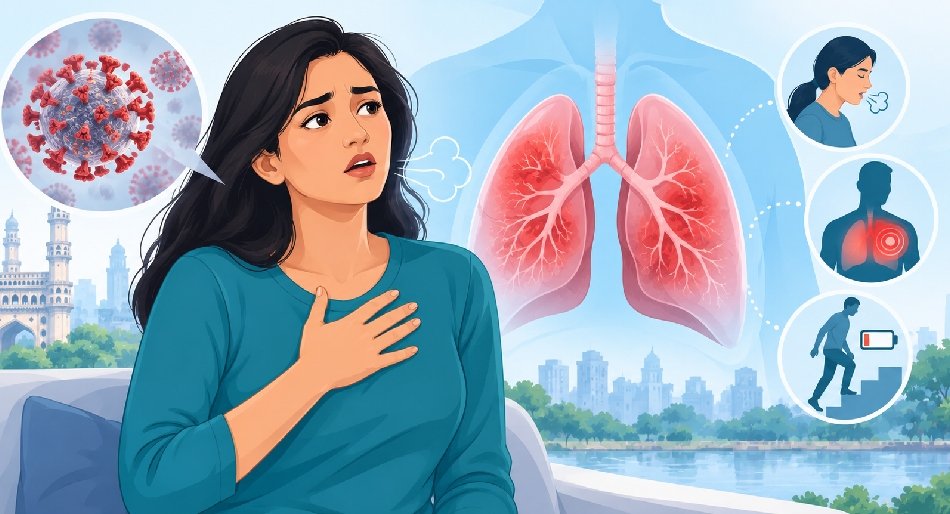
Breathlessness that outlasts a COVID-19 infection is common, and it doesn’t always mean your lungs are damaged. Around 6 in 100 people who catch COVID-19 develop post COVID-19 condition, and breathlessness is one of the symptoms reported most often (World Health Organization). Here’s what lingering breathing problems after COVID usually mean, which tests are worth doing, and how breathing capacity gets rebuilt.
Key Takeaways
- Breathlessness is one of the most common long COVID symptoms, and global estimates suggest about 6 in 100 people with COVID-19 develop post COVID-19 condition (World Health Organization).
- Lung function is often normal. In 48 patients with long COVID and disordered breathing, pulmonary function tests sat within normal limits in every case (BMJ Open Respiratory Research, 2023).
- In a cohort of 929 patients with persistent pulmonary symptoms, 51 percent had reduced gas transfer or restriction on testing (JCI Insight, 2024).
- Most people improve over months rather than weeks, and WHO reports that about 15 in 100 still have symptoms at 12 months.
- Breathing retraining, paced activity and treatment of sleep related breathing problems do most of the work.
What Does Long COVID Breathlessness Actually Feel Like?
Most people describe air hunger: the sense that a breath won’t go deep enough, even when the oximeter reads a normal oxygen level. In a case series of 48 patients with long COVID, 75.6 percent reported faster or deeper breathing and 46.3 percent said they couldn’t breathe deeply at all (BMJ Open Respiratory Research, 2023).
The pattern is often out of proportion to the effort. One flight of stairs can feel like a sprint while sitting still feels fine. Many people sigh repeatedly, yawn more than usual, or feel a tight chest and a constant urge to take a deep breath.
Why Do Your Lungs Still Struggle Months After COVID?
Two problems can produce the same sensation and they need different answers. The first is a sensitised airway: in a study of 4,211 patients with long term respiratory symptoms, 80.46 percent had a positive bronchial provocation test, meaning their airways narrowed more easily than normal (Frontiers in Medicine, 2025).
The second, and the most often missed, is dysfunctional breathing. Rate and depth drift into an inefficient pattern that clears too much carbon dioxide, and that alone causes dizziness, chest tightness and breathlessness. Healing lung tissue and muscle weakness after weeks of rest add to it.
How Common Are Post COVID Lung Symptoms?
Respiratory symptoms after COVID aren’t universal, and the severity of the first illness changes the odds. A systematic review of 42 studies covering 30,682 patients found estimates of post COVID condition from 10 to 30 percent in non-hospitalised patients and 50 to 70 percent in those who were hospitalised (Pulmonary Medicine, 2026). The reason for the breathlessness varies, and the table below maps the common patterns.
| What is driving the breathlessness | Clue you may notice | What usually helps |
|---|---|---|
| Slowly healing lung tissue | Breathlessness that eases gradually, with cough and fatigue | Time, review of imaging, graded activity |
| Reduced gas transfer | Breathless on inclines, oxygen normal at rest | Lung function testing, paced exercise |
| Dysfunctional breathing | Cannot fill the lungs, frequent sighing, normal tests | Breathing retraining with a physiotherapist |
| Deconditioning | Everything feels harder, but effort builds tolerance | Graded activity, strength work, pacing |
| Sleep related breathing disorder | Morning headache, snoring, unrefreshing sleep | Sleep study, then apnea treatment |
Breathless three months after COVID? A lung assessment finds the cause.
Does Long COVID Cause Permanent Lung Damage?
For most people it doesn’t, and lung function usually improves over months. WHO reports that symptoms generally improve over 4 to 9 months, with about 15 in 100 people still symptomatic at 12 months (World Health Organization).
Scarring is real but concentrated in the sickest patients. In a cohort of 929 patients with persistent pulmonary symptoms, 51 percent showed reduced gas transfer or restriction on repeat testing, and invasive ventilation during the first infection carried the highest risk (JCI Insight, 2024). If you managed a mild infection at home, you’re far less likely to be in that group.
What Lung Function Tests Can and Cannot Tell You
Spirometry and diffusion capacity measure how well air moves through your airways and how well oxygen crosses into your blood. They’re the backbone of assessment, and the pulmonary function tests used here take under an hour.
What they can’t do is explain every symptom. In the case series of 48 patients with disordered breathing, lung function was normal in all of them, yet quality of life scores sat well below reference values. A normal test doesn’t mean your breathlessness is imagined.
| Test | What it measures | What a normal result doesn’t rule out |
|---|---|---|
| Spirometry | Airflow and lung volumes | Disordered breathing, deconditioning |
| Diffusion capacity | How well oxygen reaches the blood | Mild impairment, muscle fatigue |
| CT scan | Scarring, inflammation, small clots | Airway sensitivity, breathing pattern problems |
| Six minute walk test | Distance covered, oxygen drop on effort | Symptoms that appear only at rest |
How Do You Rebuild Breathing Capacity Without Crashing?
Slowly, and with pacing rather than pushing through. WHO notes that many symptoms and functional limitations after COVID respond to rehabilitation (WHO). Breathing retraining comes first for a disordered pattern: nasal breathing at a slower rate, quiet low chest movement, and a return to normal breathing after exertion instead of repeated sighing.
Activity comes second, starting below the level that triggers a crash and rising in small steps each week. Watch for post exertional malaise, where effort produces a disproportionate collapse the next day. That pattern calls for a step back, not a harder push. If a cough lingers alongside the breathlessness, this guide to a chronic cough that won’t go away explains when it needs investigating.
When the Breathlessness Starts at Night
If breathing feels worse lying down, or you wake unrefreshed with a headache and a dry mouth, the answer may sit in sleep rather than in the lung tissue. The American Academy of Sleep Medicine notes that people with long term lung injury may be at greater risk of sleep related breathing disorders, and advises an evaluation to rule out obstructive sleep apnea and sleep related hypoxia (AASM).
This matters because untreated apnea keeps oxygen dipping overnight and makes daytime breathlessness feel worse. Positive airway pressure remains first line treatment for moderate to severe obstructive sleep apnea, and this guide to CPAP therapy for sleep apnea covers how it works and what the alternatives are. Not sure which problem you have? An insomnia or sleep apnea self-check is a sensible first step, and the wider range of options sits in this guide to sleep apnea treatment in Hyderabad.
Which Symptoms Mean You Should See a Pulmonologist?
Book a review if breathlessness is worsening rather than easing, if it appears at rest, or if it’s still limiting you 12 weeks after the infection. The American Lung Association lists more than 200 reported long COVID symptoms across multiple organ systems, which is why a structured assessment beats guessing.
Some signs need urgent care rather than an appointment: chest pain, coughing blood, bluish lips, fainting, or oxygen levels that fall with mild activity. Outside those, a review usually combines history, examination, lung function testing and imaging, then builds a plan around the pattern found.
The Recovery Timeline: What Improving Actually Looks Like
Recovery is gradual and rarely linear. Most people notice the first real change between month three and month six, and gains show up as a longer walk before breathlessness, fewer sighs during the day, and better sleep rather than one dramatic improvement. Judge progress by function: climbing a flight without stopping counts, even if a deep breath still feels slightly out of reach.
If nothing has shifted by month six, or things are sliding backwards, that’s the point to widen the investigation rather than wait longer.
Lingering breathlessness deserves a proper answer, not another month of waiting.
