
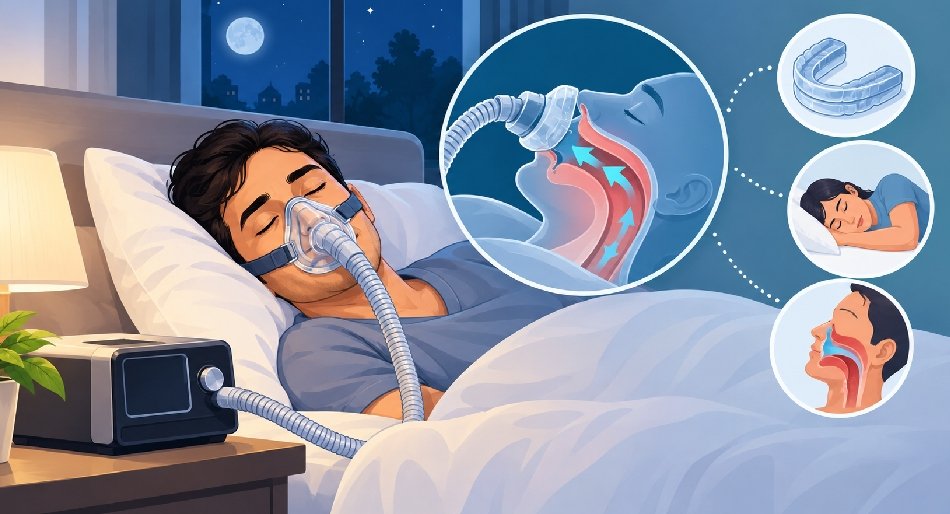
Sleep apnea makes you stop breathing dozens or even hundreds of times a night, and every pause starves your heart, brain, and blood vessels of oxygen. CPAP therapy keeps that airway open, which is why it remains the first choice for moderate to severe obstructive sleep apnea. Here is how a CPAP machine for sleep apnea works, how well it holds up in real life, and which alternatives are worth considering when a mask does not suit you.
Key Takeaways
- CPAP therapy delivers steady air pressure through a mask to stop the airway from collapsing, and it stays the first-line treatment for moderate to severe obstructive sleep apnea (American Academy of Sleep Medicine).
- Around 936 million adults aged 30 to 69 have mild to severe sleep apnea worldwide, and India sits among the four most affected countries (The Lancet Respiratory Medicine, 2019).
- Roughly 80 percent of cases stay undiagnosed, so loud snoring and daytime fatigue often go untreated for years (American Academy of Sleep Medicine).
- CPAP helps most when used at least 4 hours a night on 70 percent of nights, the adherence benchmark the AASM uses to judge treatment success.
What Is CPAP Therapy and How Does It Work?
CPAP stands for continuous positive airway pressure. The machine pulls in room air, pressurises it, and pushes a gentle, constant stream through a hose and mask into your throat. That steady pressure acts like an invisible splint: it keeps the soft tissue at the back of your airway from sagging shut when your muscles relax in sleep. With the airway held open, oxygen levels stay stable and the brain stops firing the tiny wake-up signals that ruin deep sleep.
Untreated obstructive sleep apnea is linked to high blood pressure, heart disease, stroke, and a sharply higher risk of traffic accidents. The American Academy of Sleep Medicine classifies CPAP as the most effective therapy for moderate to severe disease, and a diagnostic sleep study is what confirms how often your breathing pauses. The fix is mechanical, not a drug, which is why it works the same way on night one and night one thousand.
What Are the Parts of a CPAP Machine for Sleep Apnea?
A CPAP machine is simpler than it looks, and each part solves one comfort problem. The blower unit sits on your bedside table and sets the pressure. A humidifier warms and moistens the air so your nose does not dry out. The hose carries the air from the unit to your face. The mask is the part that decides whether therapy feels easy or unbearable, and it is the only component you truly have to get right.
Masks come in three main families. A nasal mask covers just the nose. Nasal pillows sit directly under the nostrils, with almost nothing on your face. A full-face mask covers the nose and mouth for people who breathe through the mouth at night. Many sleep labs let you trial different masks before you commit, because a poor seal leaks air, wakes you up, and quietly destroys adherence.
How Effective Is CPAP Therapy for Sleep Apnea?
CPAP is highly effective when it is used, and the honest number for “used” is lower than most people expect. A 2025 cohort study found that 45 percent of patients were highly adherent two years after starting therapy, while 39 percent had stopped using it regularly (NIH study data, sleep clinic cohort). The AASM defines success as at least 4 hours of use on 70 percent of nights. Patients who build that habit in the first month tend to keep it.
45%
highly adherent
Highly adherent: 45%
Non-adherent: 39%
Low adherence: 16%
Adherence two years after CPAP initiation (sleep clinic cohort, 2025)
Where CPAP delivers its clearest payoff is in the harder-to-see outcomes. Consistent use pulls down blood pressure, eases daytime sleepiness, and improves alertness behind the wheel. Untreated sleep apnea raises the odds of a road traffic accident by 123 percent, a risk the WHO Eastern Mediterranean Health Journal documented in a systematic review. For a driver or a shift worker, that single number is often the reason therapy changes a life.
Not sure whether snoring or daytime fatigue needs a sleep study?
CPAP and Its Alternatives: Comparing Sleep Apnea Treatment Options
CPAP is the benchmark, but it is not the only path. For mild apnea, or when a mask simply cannot be tolerated, several alternatives reduce breathing pauses. The right choice depends on how severe your apnea is, where the blockage sits, and what you can realistically use every night. A sleep specialist matches the treatment to the airway, not the other way round.
| Treatment | How It Works | Often Suits |
|---|---|---|
| CPAP therapy | Constant pressurised air holds the airway open | Moderate to severe apnea of any cause |
| Oral appliance | A custom mouthpiece pulls the lower jaw forward | Mild to moderate apnea, jaw-position related |
| Positional therapy | Keeps you off your back so the airway stays open | Apnea that worsens only when supine |
| Upper airway surgery | Removes or reshapes blocking tissue | A clear anatomical obstruction, such as large tonsils |
| Nerve stimulation | A small implant nudges the tongue muscle forward | Selected cases where CPAP fails |
Two things are true across every option. First, none of them works if it is abandoned, so comfort and follow-up matter as much as the device itself. Second, weight and lifestyle still move the needle: even a modest drop in weight can reduce how many times the airway collapses each night.
Adjusting to CPAP Therapy: Comfort Tips That Improve Adherence
Most people who quit CPAP do it in the first few weeks, and most of the time a fixable comfort problem is to blame. A leaking or ill-fitting mask is the single biggest culprit, so it is worth trialling more than one type before settling. A heated humidifier stops the dry nose and throat that send many users back to the bedside drawer.
Give yourself a runway. Wear the mask for short periods while awake to build tolerance. Use the ramp feature so pressure climbs slowly as you drift off. Keep the mask clean, replace worn cushions, and sleep on your side if your apnea is position-dependent. If insomnia is also part of your picture, treating the two together lifts the odds of success, which is exactly how CBT-I in Hyderabad pairs behavioural sleep therapy with airway treatment.
When Should You See a Sleep Specialist About Sleep Apnea Treatment?
Book an assessment if a partner has seen you stop breathing, if you wake gasping, or if you nod off during meetings or at traffic lights. Morning headaches, unrefreshing sleep, and blood pressure that stays high despite medication are other signals worth acting on. The NIH flags up to 80 percent of moderate to severe cases as undiagnosed, so waiting for symptoms to feel “serious” is how the condition quietly damages the heart.
A specialist confirms the diagnosis with a sleep study, then matches the treatment to your airway and lifestyle. Thin, non-obese adults can still have apnea that hides in facial structure, which is why thin people with sleep apnea are so often missed. If you are unsure which condition you have, an insomnia or sleep apnea self-check is a sensible first step before any machine is prescribed. The full range of options is set out in this guide to sleep apnea treatment in Hyderabad.
For a deeper look at how untreated apnea affects the heart and brain, the Lancet Respiratory Medicine global prevalence study remains the reference point for why early diagnosis matters.
Sleep apnea is treatable. Finding the right fit for you starts with one conversation.
