
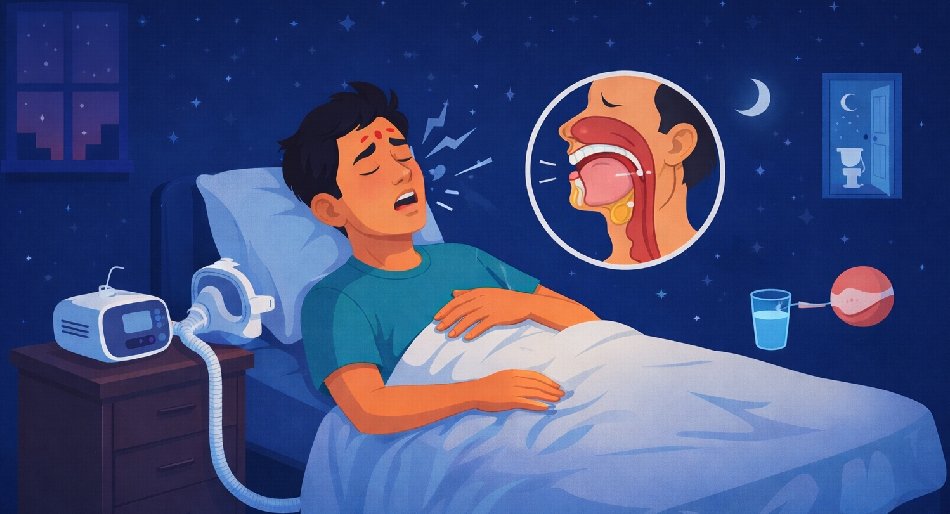
If you were asked to picture a typical sleep apnea patient, you’d probably imagine a middle-aged man with a heavy build, a thick neck, and a loud snore that shakes the walls. It is a stereotype that has persisted for decades: only overweight people get Obstructive Sleep Apnea (OSA).
But in India, this stereotype is dangerous. It leads to thousands of misdiagnoses every year.
A significant number of patients walking into sleep clinics in Mumbai, Delhi, or Bangalore possess a lean frame. They have a normal BMI, they don’t look “unhealthy,” yet they are choking in their sleep. This condition—sleep apnea in non-obese Indians—is a growing concern that medical professionals are finally starting to highlight with urgency.
If you are thin but wake up tired, this guide is for you. We are going to unravel why OSA in the lean Indian population is rising, the unique biological reasons behind it, and how to treat it effectively.
Shattering the Myth: The Indian Paradox
For years, doctors used Body Mass Index (BMI) as a primary red flag for sleep disorders. If you were thin, sleep apnea was often ruled out immediately. However, recent clinical data regarding the prevalence of OSA in lean Indians has thrown a wrench in that logic.
Research indicates that Indians are prone to sleep apnea at much lower BMIs compared to Caucasians. In the West, a BMI over 30 (Obese) is a major predictor. In India, patients with a BMI of 23 or 24—technically within the “normal” range—often present with severe airway obstruction.
Why is this happening? Looking thin on the outside doesn’t tell the full story of what is happening inside the body or of the upper airway’s structural integrity.
The “Why”: Causes of Sleep Apnea in Thin Indians
If weight isn’t crushing the airway from the outside, what is causing the blockage? When we examine the causes of sleep apnea in thin Indians, two major factors stand out: the specific “Thin-Fat” phenotype and craniofacial structure.
1. The “Thin-Fat” Indian Phenotype
You may have heard the term “skinny fat.” Medically, this is known as the Asian Indian Phenotype. Even if an Indian person has a normal BMI, they often have a higher percentage of body fat and lower muscle mass compared to other ethnicities.
Crucially, this fat distribution is different. In Caucasians, fat is often subcutaneous (under the skin). In Indians, fat tends to deposit viscerally (around the organs) and ectopically. Ectopic fat deposition means fat is stored in places it shouldn’t be, including the parapharyngeal fat pads—the tissues surrounding the airway.
You might not see a “double chin” or a thick neck, but the internal soft tissues of the throat may have enough fatty infiltration to narrow the passage. When muscles relax during sleep, these heavier tissues collapse the airway.
2. Craniofacial Morphology: It’s All in the Jaw
This is perhaps the most significant factor. Craniofacial morphology and sleep apnea in Indians are deeply linked. The human airway is essentially a box (the jaws) containing a specific volume of contents (the tongue and soft tissues).
Many Indians are genetically predisposed to having a smaller “box,” which crowds the airway:
- Retrognathia: A receding chin or a lower jaw (mandible) that is set further back toward the neck.
- Narrow Maxilla: A high, arched hard palate and a narrower upper jaw.
- Macroglossia relative to jaw size: The tongue isn’t necessarily huge, but the jaw is too small to house it comfortably.
When you lie down to sleep, gravity takes over. If your jaw is already small or set back, there is less room for your tongue. The tongue falls back, sealing the airway shut—regardless of how much you weigh. This anatomical disadvantage is a leading driver of risk factors for sleep apnea in thin Indians.
| Feature | Obese Indian Patient | Non-Obese (Lean) Indian Patient |
|---|---|---|
| Primary Cause | Excessive neck fat / Obesity | Facial structure (small jaw), & Visceral fat |
| BMI | > 25 kg/m² | < 23 kg/m² (Normal range) |
| Neck Circumference | Usually large (> 17 inches) | Often normal or slender |
| Visible Symptoms | Loud, thunderous snoring | Mild snoring, and often upper airway resistance |
| Genetics/History | Metabolic syndrome | History of receding chin/crowded teeth |
The Hidden Signs: Symptoms of Sleep Apnea in Non-Obese Indians
Because thin people don’t fit the “profile,” they often ignore their symptoms. They attribute their fatigue to stress, work hours, or nutritional deficiencies. However, the symptoms of sleep apnea in non-obese Indians can be distinct and sometimes more subtle than in obese patients.
While loud snoring is common, non-obese patients might experience Upper Airway Resistance Syndrome (UARS) before full-blown apnea. This means they might not snore like a freight train, but they are working incredibly hard to breathe. This increased effort triggers a “fight or flight” response, leading to fragmented, unrefreshing sleep.
Watch out for these specific signs:
- Unexplained Daytime Fatigue: Feeling physically drained despite getting 7-8 hours of sleep.
- Morning Headaches: Often caused by oxygen deprivation or carbon dioxide buildup during the night.
- Dry Mouth: A classic sign of open-mouth breathing to compensate for a blocked nose or throat.
- Nocturia: Waking up frequently to urinate. The heart, stressed by breathing struggles, signals the kidneys to dump fluid.
- Silent Pauses: A bed partner might notice you stop breathing or gasp, even if the snoring isn’t incredibly loud.
Diagnosing Sleep Apnea in Non-Obese Indian Adults
If you suspect you have this condition, how do you prove it? Diagnosing sleep apnea in non-obese Indian adults requires a shift in perspective.
Do not rely on a physical exam alone. A general practitioner looking at a thin neck might say, “You’re fine, it’s just stress.” You need objective data to see what is happening physiologically.
1. Polysomnography (The Sleep Study)
This is the gold standard. Whether done in a lab or via a Home Sleep Test (HST), it measures your AHI (Apnea-Hypopnea Index). It tells you exactly how many times you stop breathing or have shallow breathing per hour. For lean patients, even mild sleep apnea (AHI 5-15) can cause significant symptoms due to the high effort of breathing.
2. Drug-Induced Sleep Endoscopy (DISE)
For non-obese patients, DISE is exceptionally valuable. A doctor sedates you to induce sleep and uses a flexible camera to see exactly where the collapse is happening. Is it the tongue base falling back? Is it the epiglottis? Since external fat isn’t the main issue, pinpointing the precise structural point of collapse is vital for choosing the right treatment.
Treatment and Management Strategies
Once diagnosed, the management of sleep apnea in non-obese Indians differs slightly from that of obese patients. Since “losing weight” isn’t a viable solution for someone who is already lean, we have to look at mechanical and anatomical interventions.
1. CPAP Therapy (Continuous Positive Airway Pressure)
CPAP remains the most effective treatment for airway opening. It acts as a pneumatic splint, blowing air to keep the throat tissues from collapsing. However, lean patients sometimes struggle with high pressures. “Auto-CPAP” machines that adjust pressure breath-by-breath are often better tolerated by non-obese individuals.
2. Oral Appliances (Mandibular Advancement Devices)
For obstructive sleep apnea in non-obese Indians, treatment is often a game-changer. Since the cause is frequently a receding jaw (retrognathia), a custom-made dental device can push the lower jaw forward during sleep. This movement mechanically pulls the tongue forward and opens the airway behind it.
3. Myofunctional Therapy
Think of this as physical therapy for your tongue and throat. These exercises strengthen the oropharyngeal muscles, so they don’t collapse as easily during sleep. For lean patients where muscle tone is the issue rather than fat bulk, this can be a highly effective adjunct therapy.
4. Surgical Options
If the jaw structure is severely retrognathic, surgeries like Maxillomandibular Advancement (MMA) might be considered to permanently widen the airway by physically moving the skeletal structure forward. This is usually reserved for those who cannot tolerate CPAP or oral appliances.
| Treatment Option | Best Suited For | Pros | Cons |
|---|---|---|---|
| CPAP Machine | Moderate to Severe OSA | 100% efficacy if used; Gold standard | Can be uncomfortable; mask leakage |
| Oral Appliance (MAD) | Mild to Moderate OSA; Retruded Jaw | Discreet; no electricity needed; comfortable | It can cause jaw soreness or changes in bite |
| Myofunctional Therapy | Mild OSA; Children; Adjunct therapy | Non-invasive; zero side effects | Requires high discipline and time |
| Positional Therapy | Positional apnea patients | Simple, low cost | Ineffective if apnea occurs in all positions |
Conclusion: Don’t ignore the snore.
It is time to rewrite the narrative. Sleep apnea is not a disease of the obese; it is a disease of the airway. For the Indian population, genetics and facial structure play a massive role that often gets overlooked in general practice.
If you are thin, fit, but constantly exhausted, do not let a normal BMI give you a false sense of security. The risk factors for sleep apnea in thin Indians are real. Ignoring them can lead to hypertension, cardiovascular issues, and metabolic disorders down the road.
Your fatigue is not normal. If you recognize these symptoms, consult a sleep specialist, insist on a sleep study, and reclaim the rest your body requires.
Frequently Asked Questions (FAQs)
Yes, absolutely. In the Indian population, skeletal structure plays a bigger role than weight. You can be underweight and still have a narrow throat or a receding chin that causes the airway to collapse during sleep. Do not rule out sleep apnea based on weight alone.
No. While CPAP is highly effective, non-obese patients often respond very well to Oral Appliances (Mandibular Advancement Devices). Since the issue is often the position of the jaw rather than excess fat, a device that moves the jaw forward can sometimes resolve the blockage effectively without the need for a machine.
Yes. Even if you look thin, Indians are genetically predisposed to having higher visceral fat and fat deposits within the soft tissues of the neck and tongue. This "hidden" fat can narrow the airway significantly, contributing to sleep apnea despite a normal waistline.
Diet helps, but not for "weight loss" in this context. An anti-inflammatory diet can reduce swelling in the nasal passages and throat tissues. Furthermore, avoiding alcohol and heavy meals before bed is crucial, as these relax the throat muscles and worsen the collapse, regardless of your body weight.
